

Our Vision and Mission
Our vision is a world in which every young person has the chance to develop to their full potential, lead a self-determined and fulfilled life and help shape our society.
We offer educational institutions a framework for non-formal education and experiential learning and support them in implementing it. The Duke of Edinburgh’s International Award promotes
- independent learning and intrinsic motivation through the experience of self-efficacy and recognition
- self-confidence, resilience and other key socio-emotional skills
- personal development
We encourage educational institutions to develop into places where potential can be realised and to network with their environment. We motivate young people to work towards social and ecological transformation.
Our Impact
Please refer to our German page to find out more about our Theory of Change and our Impact.
Find out more about our Impact & Theory of Change
Please find our Annual Impact Reports (according to Social Reporting Standards) here:
Wirkungsbericht 2025 Wirkungsbericht 2024 Wirkungsbericht 2023 Wirkungsbericht 2022 Wirkungsbericht 2021 Wirkungsbericht 2020Our goals for 2030
In 2030
- at least 10,000 young people will start their Award programme each year
- at least 5,000 young people will start their Award programme each year at public schools
- at least 2,500 young people will start their Award programme each year at schools with a social index > 4
- at least 75% of participants will successfully complete their Award
- at least 75% of the participants taking part in our outcomes evaluation state that they have gained in self-confidence and resilience as a result of their participation in the Award programme
- at least 75% of the participants taking part in our outcomes evaluation state that they want to change their behaviour as a result of their participation in the Duke, by volunteering more, being more active in sports and living healthier, developing their talents more and spending more time in nature.
- A scientific evaluation of the Duke programme has shown that the labour market prospects of participants from socio-economically challenging backgrounds improve as a result of their participation in the Award programme.
Our Team
Our team consists out of people who are passionate about developing potential and equal opportunities and who want to contribute to the realization of UN children’s rights and the Sustainable Development Goals. In doing so, we take the Duke Award motto to heart: We can do more than we think!
We have offices in Berlin, NRW, Sachsen and Baden-Württemberg.
Get to know our team
Our Advisory Board
Our Advisory Board advises and supports our team in the strategic direction of our association.
Get to know our advisory board
Become part of our team
You have various opportunities to contribute your wishes, thoughts and ideas to our association!
- Volunteering: People who would like to support the Award on a voluntary basis can apply to us.
- Association member: You can join the association and help influence our strategic direction at our member meetings and have a direct impact on educational equality in Germany.
- Active: Award participants also have a direct path to our decision-making table – via the Youth Ambassador Program.
- Alumni: Award alumni can become members of the Alumni Association (more information to follow). You are also welcome to visit the Award Alumni Community on LinkedIn and add your Award to your CV.
- Job: If you are currently looking for a career change and would like to apply to us, we are happy to receive unsolicited applications. You can also visit our job board, where we regularly publish job advertisements. We look forward to hearing from you!
The Duke of Edinburgh's International Award Foundation
Our association is licensed by The Duke of Edinburgh’s International Award Foundation which supports and assists National Award Operators in more than 65 countries.
We are also part of the alliance of the largest global youth movements “The Big Six” and cooperate with the UN and WHO in ongoing projects.
The history of the Award
The history of the Duke of Edinburgh’s Award
Where it all began – Kurt Hahn’s vision
The origins of the Duke of Edinburgh’s Award date back to the 1920s – a time of social upheaval when new approaches to education were being sought. At the centre of it all was a man with an extraordinary idea: Dr Kurt Hahn, a German educator, visionary and staunch advocate of values-based education.
Hahn was convinced that education should not be limited to the mere transfer of knowledge. It must enable young people to take responsibility, overcome crises, stand up for themselves and others, and actively support fundamental democratic values. For him, it was clear that character is not formed in the classroom alone, but in real life – through experience, challenge and community.
Together with Prince Max von Baden, he founded the Schule Schloss Salem school on Lake Constance in 1920 – one of the first schools to implement a holistic educational concept. Hahn’s goal was to prepare young people not only for academic achievement, but also for social responsibility and democratic participation. Personalities such as Robert Bosch supported this reform pedagogy ideologically and recognised the importance of an ethically based education for a stable, free society.
After the National Socialists seized power, Hahn, as an avowed democrat and opponent of the regime, was forced to leave Germany. He continued his work in exile in Britain, having previously studied at Oxford.
Hahn’s goal was always to reach as many young people as possible. After introducing the Gordonstoun Badge at Gordonstoun in 1934 as a focus for extracurricular activities, the decisive breakthrough came in 1936 with the Moray Badge, in which all boys in the county were now allowed to participate. The badge comprised six parts (including swimming/lifesaving, athletics and expeditions, but not yet service and skills), three age groups and, in each age group, standard and silver levels.
At a headteachers’ conference in Oxford in January 1938, Hahn finally presented the idea of a nationwide County Badge with the four elements we know today. This was taken up by counties such as Hertfordshire, but the Second World War prevented it from spreading further.
The war year 1941 saw the founding of another of Hahn’s creations. Together with shipowner Laurence Holt, he founded the first ‘Outward Bound School’ in Aberdovey, on the west coast of Wales, where the County Badge handbook served as the basis for four-week courses for students, mostly aged 16 to 20.
The idea of a youth achievement badge was revived in 1954 when Hahn asked Prince Philip for support for a new attempt. Hahn convened a committee to design a national programme based on the earlier badges. The result was the introduction of the Duke of Edinburgh’s Award in 1956, with Sir John Hunt, leader of the first successful Mount Everest expedition, as its director.
The programme quickly spread to other countries, and in 1988 the global programme was formally established in Australia. Today, the Duke of Edinburgh’s International Award Foundation oversees compliance with the principles, recognises national issuers, provides a platform for discussion and communication, and hosts the International Secretariat in London.
Since 1956, the Award has developed into the world’s leading development programme for young people. What once began in Great Britain has become a global movement: today, the Duke of Edinburgh’s Award is active in over 130 countries and has encouraged millions of young people to realise their potential – regardless of their background, education or social circumstances.
In Germany, several organisations that were already working with the programme under the direct supervision of the International Secretariat founded the National Award Office in 1994. In 1996, it was recognised by the Baden-Württemberg Ministry of Culture and Sport as an independent youth welfare organisation and by the world programme as the German programme publisher. One of the Award Centres is Schule Schloss Salem, where it all began in 1920.
Ten years after the Duke of Edinburgh’s Award was founded, Hahn established the international school movement United World Colleges (UWC), which sees education as an instrument of peace between cultures.
Children's rights and SDGs
By enabling young people to participate in the Award, educational institutions actively support the realisation of the UN Convention on the Rights of the Child, whose fundamental principles are the requirement of equal treatment Other rights of the CRC that are promoted by participation in the Award are:
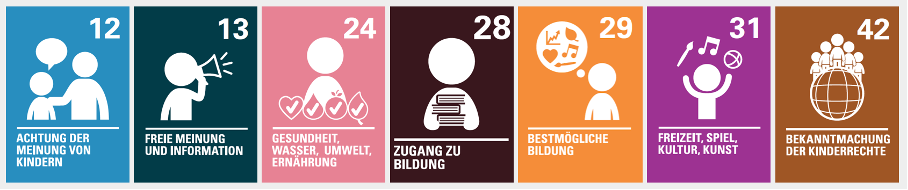
Our work contributes particularly to the following SDGs:
Why children's rights help to empower young people SDGs and the Award